The 504 Sit-In: The Civil Rights Victory Many Still Don’t Know
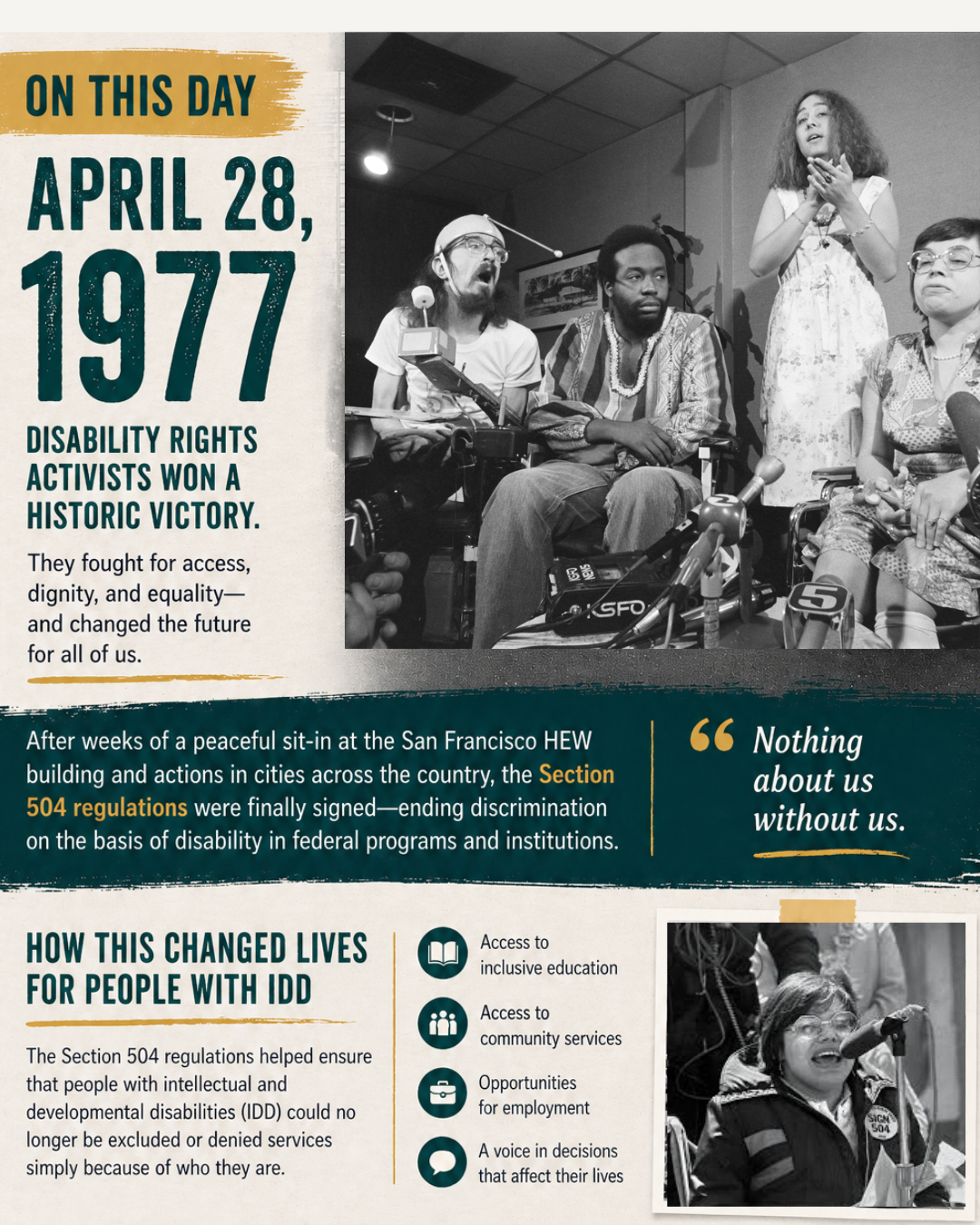
What can happen when a community comes together to support some of its most vulnerable citizens? And what can happen when those citizens are empowered to speak up for themselves? On this day 49 years ago, one of the most important civil rights protests that most of the public has never heard of ended in a victory for the disabled community when the Section 504 regulations of the 1973 Rehabilitation Act were finally signed and became binding regulations. The years of hard work and acts of community care that led up to this moment make for a story that every American citizen should know and be inspired by, where disability rights went from a legal promise to a lived reality.
While the Rehabilitation Act was passed in 1973, with Section 504 of the act forbidding discrimination on the basis of disability in federal institutions and programs and requiring them to provide accommodations, actual implementation of the law stalled for years. With no specific published regulations about what counted as “reasonable accommodations” or “discrimination,” there was little that a disabled citizen could do to ask for enforcement of the law. Without these regulations, disabled people did not have the recourse to demand access to public education, employment, or even something as simple as the ability to enter a government building or use a sidewalk.
After four years of waiting and campaigning for the regulations to be signed and published, with multiple setbacks from administration changes and pushback from business lobbyists, activists were determined to make the change happen themselves. On April 5, 1977, disability rights activists in ten cities entered regional offices for the Department of Health, Education and Welfare (the precursor for the Department of Health and Human Services) and demanded that Secretary of HEW Joseph Califano sign and publish the 504 regulations without any further delay. As days stretched on, all but one of these sit-ins ended without resolution. The San Francisco sit-in at 50 UN Plaza, consisting of approximately 120 people and led by figures including famed disability rights activists Judy Heumann and Kitty Cone, would last for several weeks and garner support from not only the disabled community but from the larger community as well.
Hot water and phone lines were shut off by the police after several days, and many protestors with complex medical needs were having to do without their everyday accommodations. Fortunately, the protest was able to continue due to help from outside, including many other organizations who were involved in other aspects of the civil rights movement. The Black Panthers, Vietnam War veterans, LGBTQ+ cooperatives, trade unions, churches, and many others provided hot food, medical supplies, and moral and logistical support for everyone inside 50 UN Plaza. Meanwhile, the participants of the sit-in were building the framework of what would become a more unified and active disability rights community, based on the solidarity of shared experiences and mutual aid rather than isolation based on medical categories. Activists who were blind, Deaf, paraplegic, intellectually disabled, and members of many other communities were interacting with each other for the first time in many cases and finding that they were more alike than different. These experiences would forge the disability rights movement that would change America for decades to come.
Dozens of protestors held press conferences within the building where they shared what they thought the public needed to know about their cause. They told reporters about the discrimination in schools and the workplace that they often faced, something that the general public was often unaware of. Several more activists, including Heumann, traveled to Washington D.C. to bring the protest to federal attention, many of them traveling in the back of a rented U-Haul truck due to the lack of accessibility on public transportation. Rallies were held outside of Secretary Califano’s home, President Carter’s church, the Capitol Building—which was also not handicapped accessible at this time— and even across the street from the White House in Lafayette Park. Just as crucially, the continuing sit-in in San Francisco was also receiving national press coverage, and the public was increasingly sympathetic towards the protestors and critical of the government representatives who were attempting to avoid them. The protest finally ended on April 28th, 1977, when the 504 Regulations were signed and published in their full and unaltered form.
In a retrospective decades later, activist Kitty Cone reflected on what the 504 Sit-Ins meant to the disabled community: “The sit-in was a truly transforming experience the likes of which most of us had never seen before or ever saw again. Those of us with disabilities were imbued with a new sense of pride, strength, community and confidence. For the first time, many of us felt proud of who we were.” Another activist stated: “It didn't matter if you were mentally (disabled), blind or Deaf. Everybody...felt, ‘We are beautiful, we are powerful, we are strong, we are important.’” Although there is still work to be done, disabled Americans have a form of concrete federal protection against discrimination due to the hard work of these activists and the community that worked to support them. This protest would inspire more movements for decades to come, including the collective action that led to the passage of the Americans with Disabilities Act in 1990, each of which would bring America closer to being a truly equitable society for all of its citizens. This is a lesson that is important to remember every day, even 49 years later; we are powerful when we work together and care for each other, and this power can allow any and all of us to make lasting change.
SOURCES:
https://www.nps.gov/articles/000/504-protest-disability-community-and-civil-rights.htm
https://web.archive.org/web/20160909052805/http://dredf.org/504-sit-in-20th-anniversary/short-history-of-the-504-sit-in/
https://www.nps.gov/articles/disabilityhistoryrightsmovement.htm
The Power of 504 (full version, open caption, English and Spanish)