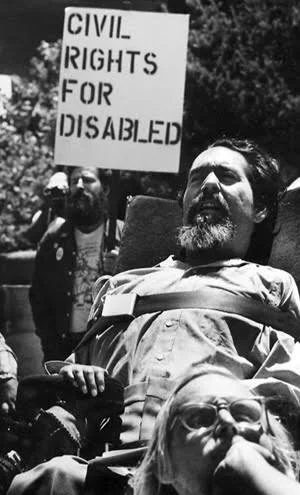
Disability Pride Month: Ed Roberts and the Independent Living Movement
At Shared Wellness, we believe every person deserves the opportunity to live, make choices, and participate fully in their community. Independent living isn't about doing everything alone—it's about having the supports needed to live a life of dignity, purpose, and connection. That vision may seem natural today, but it was hard-won. It grew out of decades of advocacy by disabled people who fought to be recognized as full and equal members of society. This Disability Pride Month, we're celebrating Ed Roberts, often called the father of the Independent Living Movement, whose leadership helped transform disability rights into a modern civil rights movement.
As a teenager, Roberts was left almost completely paralyzed below the neck by polio. He soon began to experience the roadblocks that a disabled American frequently faced at this time. He was initially denied a high school diploma due to his lack of ability to fulfill physical education requirements, and after being admitted to the University of California, Berkeley, a dean expressed skepticism about the feasibility of a “cripple” being able to attend the college and attempted to revoke his admission. When he was finally allowed to attend the school, a local newspaper headline read, "Helpless Cripple Attends CAL"; although Roberts stated that this kind of offensive wording was an exceedingly common sentiment for him to hear, he refused to apply it to himself. After Roberts won a legal battle for needed accommodations, which included turning a disused hospital wing into a dormitory capable of housing his iron lung, Berkeley began to admit other disabled students over the following years. These students would form a group that they called the Rolling Quads, which would advocate for greater accessibility for disabled students and eventually fight for services for all disabled citizens. The Rolling Quads did more than advocate for accessibility. They also challenged the idea that disability was simply a personal tragedy or medical problem, instead popularizing the idea that disability could be seen as both an identity that one could take pride in and a protected class.
Roberts would expand his disability rights work beyond his college campus. In 1972, he would lead the newly founded Center for Independent Living, a disability self-advocacy group which was the first of its kind in the United States. Instead of treating disabled people as medical cases who belonged in institutions or out of public view, the Independent Living Movement emphasized choice, self-determination, and community participation. Roberts' leadership and activism inspired the growth of the Independent Living Movement across the country. The CIL and subsequent independent living centers provided peer support and campaigned for the rights of disabled citizens to have equal access to education, employment, housing, and community engagement, and they continue to do so today. Roberts also took part in numerous civil rights protests, including the Section 504 Sit-In in San Francisco, and he would travel the world to continue to speak up for the rights of disabled individuals and to prove that members of his community were just as capable of participating in public life as anyone else. He would also eventually be named as the head of the California Department of Vocational Rehabilitation, the very agency that had once discouraged him from going to college or seeking gainful employment.
In a 1987 Partners in Policymaking session, Roberts commented on his view of disability identity and community integration: “I am a person first, and then I have a disability. And when I talk, I talk about that people have needs. That's not our whole life—my disability does not define my whole life. Because I just have normal needs, like anyone else. And wishes, and desires. And to pull people apart, segregate them, put them in separate schools, and keep themselves separately is a real crime, I feel.” The Independent Living Movement, as spearheaded by Roberts and his fellow activists, paved the way for the passage of legislation such as the ADA and the disability rights movement that still campaigns for equality to this day. Today, many of the rights and opportunities disabled people enjoy—including living, working, learning, and participating alongside everyone else in their communities—exist because of advocates like Ed Roberts. This has taken the form of community living arrangements, accessible infrastructure, and legal protection against discrimination in schools and workplaces. For this, we can thank Ed Roberts and his refusal to be restricted by societal expectations for disabled Americans. By speaking out against the obstacles that seemed permanently ingrained into the structure of society, Roberts cleared the way for countless people who came after him.
At Shared Wellness, we honor Ed Roberts' legacy by continuing to support people in living meaningful, self-directed lives within their communities. During Disability Pride Month, we celebrate not only how far we've come, but also the ongoing work of building communities where every person is valued, included, and empowered to thrive.
ADDITIONAL READING:
● Smithsonian Magazine: Ed Roberts' Wheelchair Records a Story of Obstacles Overcome
● Ed Roberts, Activist | MNDDC